
Socorro Previous Residents by Era
Different sources carry the Socorro address trail across different periods. The County Clerk's historical deed books are the strongest ownership bridge for earlier transfers. The current Official Public Records index carries recorded instruments, while regional directories and census material add household context. City permit and code files may tie activity to an address, but no public Socorro case index was located. Start with the date range of the question, then choose the source that actually covers it.
| Source | Years it covers | Where held | What it shows |
|---|---|---|---|
| Historical deed books | 1874–1963 described online | Kofile and El Paso County Clerk | Grantor-grantee and book/page trail |
| Official Public Records | Current portal; complete historical start not stated | County Clerk | Recorded instruments, dates, legal-description clues |
| UTEP and Portal directories | 1885–1906 itemized; links through 1922 | UTEP and UNT Portal | Names, addresses, occupations, street listings |
| Historical Society directories | 1886–2011 reported | Burges House collection | Address and business continuity clues |
| Federal census and newspapers | Public census release follows the federal schedule; 1950 is the latest released decennial census | Archives and Border Heritage | Household, family, move, and obituary context |
| City permits or code files | Historical online range not located | Socorro Planning, Code, or City Clerk | Address-specific application, inspection, or notice lead |
A deed establishes a recorded transfer, not continuous residence. A directory or census can place a household in time, but each is still a snapshot. Pair sources rather than promoting one hit into a complete story about past residents.
Socorro Previous Residents Start at the Parcel
Begin a previous-residents search with the El Paso Central Appraisal District, or EPCAD. Its basic property search accepts a name, address, PropertyId, or GeoID. A result can expose an account or property number, GeoID, owner name, an address field, tax-year context, pagination, and sometimes a download-result option. Preserve the access date and tax year. The interface showed 2027 work in progress during the research, with prior years described as informational, so an old address question requires more than one tax-roll view.
Do not assume EPCAD's visible address is the property situs. A tax system can hold an owner mailing address that is a different parcel, a post-office box, a business address, or an out-of-town location. Compare the parcel detail, GIS geography, and recorded legal description before calling any address a residence. EPCAD's Open Government route offers appraisal-roll, CAMA, GIS, and download information; an open-record request may be needed for material not shown online. EPCAD lists (915) 780-2131 for contact.
Note: Owner information is an address lead, while a dated transfer instrument and household source answer different historical questions.
Socorro Previous Residents and Deed Books
El Paso County uses its County Clerk as the recording office, rather than a separately named recorder. The historical Kofile route describes deed-index books from 1874 through 1963, also characterized by the county as extending from county sovereignty through 1963. Search by index-book type, year, party, last name, first name, or by book, volume, and page. Related documents can be searched, viewed, or purchased, although registration is required for purchases. The Deed of Trust series remains under construction, so a silent result may be an access limitation rather than a missing event.
For a record that predates or falls outside an available online image, contact the County Clerk for the book and page rather than treating the gap as proof that the chain ended. The downtown clerk location is 500 E San Antonio, Suite 105, El Paso, with (915) 273-3532. The County Clerk also accepts copy inquiries by email at CountyClerk@epcounty.com and maintains records-search links for official portals. Confirm current office availability before an in-person trip because the research noted a 2026 closure notice for the Ysleta Annex.
The historic El Paso deed-index search is the documented online route for the older grantor-grantee book series.
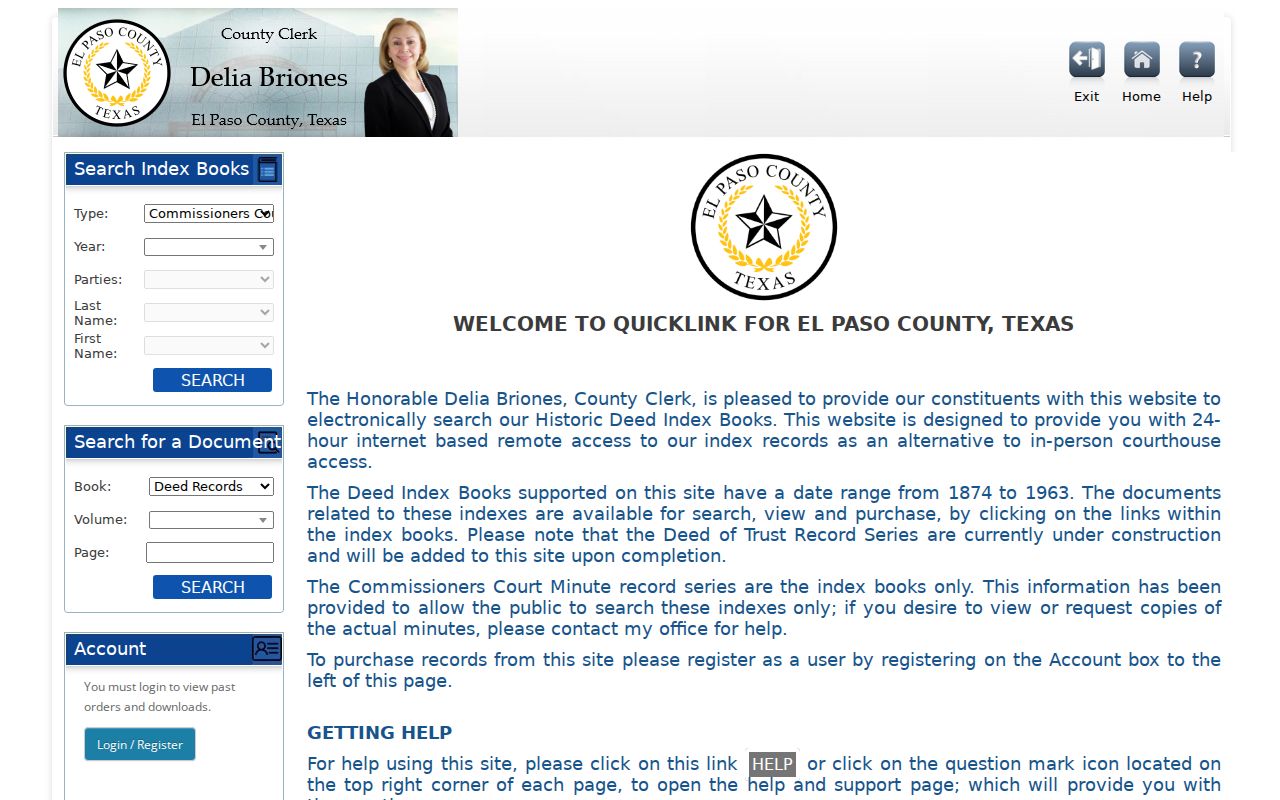
Save the party names, book and page, year, and legal-description clues from an index result before asking the clerk for a copy.
Socorro Previous Residents in Official Records
The County Clerk's Official Public Records portal is a free index, not a title commitment or legal title search. Its fields include an eleven-digit Document #, Deed Name entered last name first, Subdivision, Style, Book Number, Page, Lot, Block, Unit, Tract, and file-date range. At least one criterion is required, and the portal returns up to ten documents per search. The name field uses suffix matching, so a short ending can match a longer surname but not a matching string in the middle of a name.
Use a party name with a date, subdivision, lot, block, tract, or document style to control same-name results. A purchase deed, warranty deed, deed of trust, easement, plat, release, foreclosure paper, probate-related instrument, or affidavit of heirship can explain a change in the property record. Capture the instrument number, grantor, grantee, style, filing date, book or page, legal-description terms, and document-link status. Copies and image access can vary, and the Deed of Trust series carries a construction warning.
El Paso County Official Public Records displays the county index and its document-search fields.
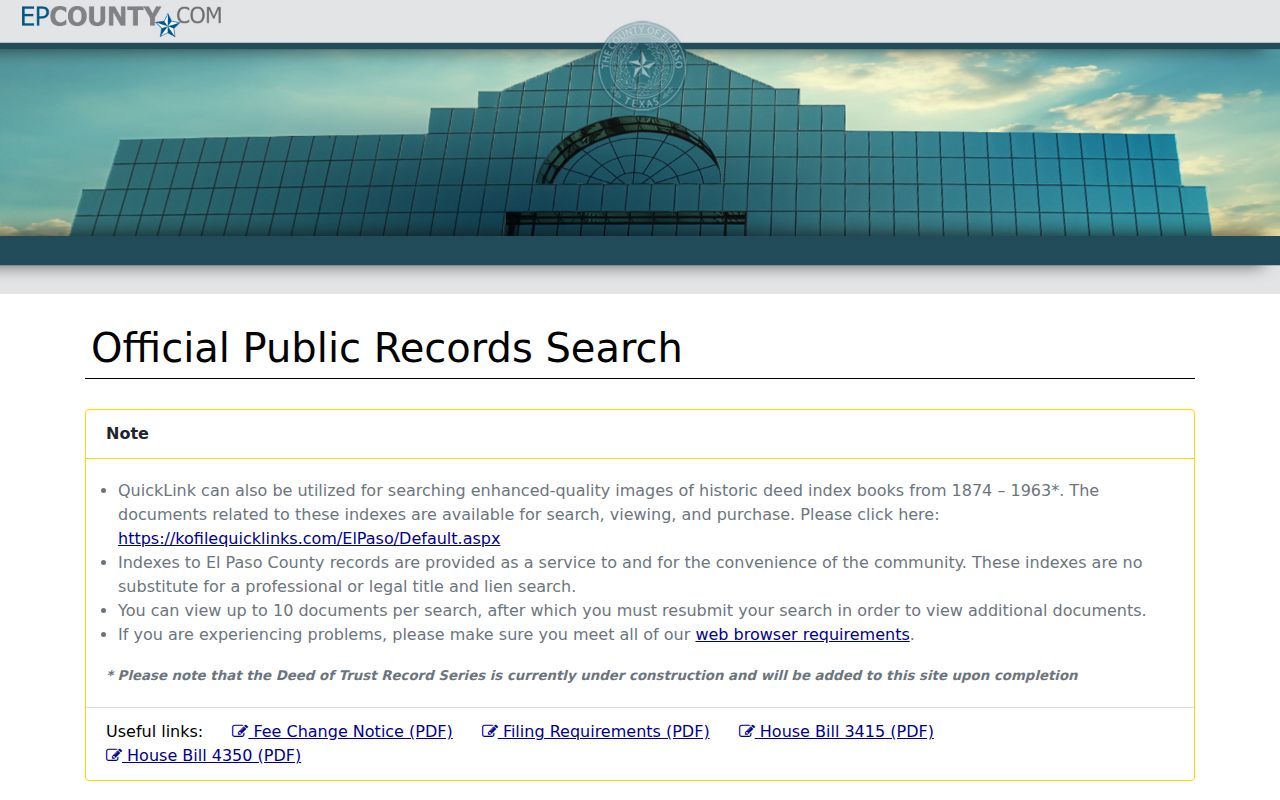
An index entry directs the next request, but the recorded instrument and a current parcel check are needed before interpreting an ownership transition.
Socorro Previous Residents Need Address Geography
Socorro's address history has more than one key. Street wording, parcel geometry, a subdivision lot and block, and a metes-and-bounds description can each identify the same place differently. A legal description often survives changes to a street label or number. GIS supplies the parcel geography, EPCAD uses account and GeoID values, the Clerk's index uses legal description and parties, and USPS standardizes a delivery address. Preserve all of those keys when moving backward.
The city’s mission, irrigation, acequia, and colonia history makes this especially important. Some older routes or informal place names may not align neatly with a current platted street. The 1881 railroad bypass, later growth, and the 1985 reincorporation after an annexation threat also affected the record geography around Socorro. No official street-renumbering schedule was located. Bridge an uncertain historical address through plats, a consistent legal description, City Clerk annexation files, Planning maps, and newspapers rather than inventing a modern match.
Trace Socorro Previous Residents Through Deeds
A backward deed chain begins with a current parcel, but it is built from parties and legal descriptions rather than a simple address lookup. First find the present owner or parcel identifiers in EPCAD. Then find the acquisition instrument in the County Clerk index. The buyer on that instrument is the grantee. The seller is the grantor. To move backward, search that seller as a grantee in the preceding transaction while carrying the legal description and date range with the search.
- Capture the EPCAD account or PropertyId, GeoID, owner lead, and legal-description detail available for the subject parcel.
- Search the current owner in Official Public Records as a likely grantee, narrowing by date, subdivision, lot, block, tract, or style.
- Open or request the acquisition instrument and record its grantor, grantee, filing date, instrument number, and prior-reference clues.
- Search that grantor as a prior grantee, using the same legal description or tract clues to reduce same-name results.
- Repeat backward until the older 1874–1963 deed books, an image gap, a split parcel, or a clerk-request step changes the route.
- Grantor
- The party transferring an interest in the instrument.
- Grantee
- The party receiving that interest. A prior seller is often the next person to search as a grantee.
- Chain of title
- The ordered series of recorded transfers or interests tied to the same property, not a list of every occupant.
- Legal description
- The lot, block, subdivision, tract, or metes-and-bounds language that identifies land more reliably than an old street label.
Plats, easements, liens, deeds of trust, releases, probate filings, heirship affidavits, and foreclosure notices can explain why a transition does not read like an ordinary sale. Compare each one against the parcel and dated household evidence.
Socorro Previous Residents in Directories and Census
Owners are only one layer of a Socorro address history. The regional directory collections can show who was printed at a street number, a business at the same number, nearby intersections, or a vacancy. The 1922 El Paso directory includes personal, street, business, classified, civic, and school sections. Its personal entries may include a name, occupation or title, employer, residence or rooming address, and telephone. The street pages can show an address number, occupant or business, intersections, and “Vacant.”
Use the printed listing as a date-specific household lead. Search a surname in consecutive available years, record spelling and address changes, then inspect the street section for the number. Pair nearby directory years with released federal census years, remembering that a directory's publication date and census enumeration date are different. The detailed collection routes are available through the Socorro Directory Book, leaving this address workflow focused on connecting household clues to the parcel trail.
The 1922 El Paso street-directory page shows the kind of number-by-number historical evidence available for an address trail.
Read a “Vacant” label as a dated publication note, not a claim about everyone who lived at the property before or after that edition.
UTEP's early directory collection provides the digitized year-and-publisher route for carrying a name or address across available volumes.
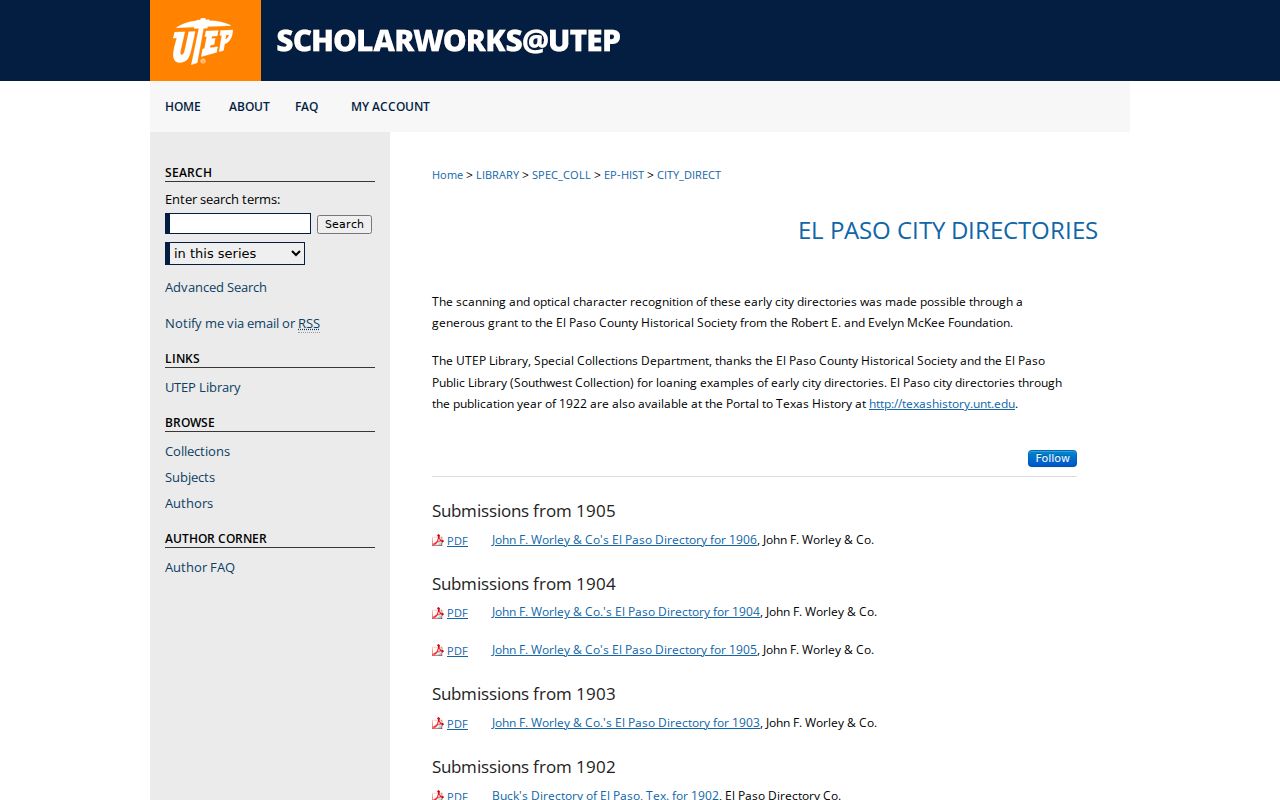
When a name disappears, test a move, a new surname form, a business listing, a missed publication, or a death record before treating it as a final endpoint.
Socorro Previous Residents and Historic Resources
Socorro's historic-resource work can add context to a house-history question without replacing recorded title evidence. The City’s Historic Preservation material connects the community to the Rio Grande valley, mission history, irrigation, vineyards, the Rio Vista and Bracero context, and later changes in the city. In 2025, the City announced a $50,000 Texas Historical Commission grant to update a Historic Resources Survey that it said had not been updated since 1995. The updated survey itself was not located in the research, so it should be treated as a developing research lead rather than a current address database.
This human-use layer is useful when a parcel, directory, photograph, or newspaper item points to a building or neighborhood story. It can help frame what to ask for from an archive or the City Clerk, such as a time-bounded ordinance, annexation document, historic-resource file, permit record, or map. It cannot identify all former occupants on its own.
Socorro Historic Preservation provides the city’s historic-resource and community context for a dated address inquiry.
Use the historic context with the deed, directory, map, and clerk-record dates already gathered for the same location.
Note: A historic-resource reference can guide research but does not establish ownership, occupancy, or a complete list of past residents.
Socorro Previous Residents Trail Endpoints
When the recorded transfer and directory trail stops, follow the kind of record that could explain the change. Border Heritage holds city directories, newspapers, obituaries, maps, cemetery and vital indexes, census material, and yearbooks. Its Heritage Hub resource provides obituary and death-notice searching with original images for library users. Probate and heirship files at the County Clerk can identify a decedent, executor, heir, attorney, or recorded estate event when the file is public and not sealed. Marriage and death indexes have their own public-age and certified-copy limits.
City permit and code records are another address-specific fallback. Socorro Planning and Zoning accepts permit forms and email at p&z@costx.us, but no public permit case index was located. Code Enforcement files may include complaints, inspections, notices, photos, and closure information, subject to release and redaction. Request a narrow address and date range through the City Clerk or the Socorro NextRequest portal. The City Clerk accepts requests online, in person, and by follow-up email or phone under the Texas Public Information Act process.
Lawful use. Socorro previous-residents research is appropriate for family history, estate questions, house history, and personal curiosity. Texas Penal Code §§42.07 and 42.072 address harassment and stalking; never use records to monitor, threaten, or contact a living person.