
Trace a Socorro Street Directory
Street-by-street work in Socorro is an address chain. Begin with the street exactly as written, then try the normalized suffix if the first EPCAD search does not return the parcel. A property result can provide the account number, GeoID, owner name, an address field, and a tax-year context. That is the anchor for the next search, not proof that every person at the address is identified. Compare a parcel with a recorded deed, a plat, a lawful voter-file request, and a historical street section when the question concerns a particular period.
- Search the Socorro address in EPCAD, then save the account or property ID, GeoID, owner name, displayed address, tax year, and access date.
- Check the parcel location and legal-description clues in GIS or city planning maps before treating the record's address as the physical property address.
- Search the current owner as the party receiving the deed in Official Public Records, adding subdivision, lot, block, date, or deed style where the name is common.
- Carry the seller's name and the legal description back through earlier instruments, plats, easements, releases, and probate-related records.
- For historical occupancy, compare the address with a directory street page, then cross-check the personal listing and nearby years.
The result is a dated property and record trail. A full named-street search should repeat that process parcel by parcel rather than inferring occupants from a map line or a shared ZIP.
Note: Repeat the same Socorro address chain for each parcel, because a street name alone is too broad for a reliable match.
Search Socorro Streets in EPCAD
The EPCAD basic search accepts a name, address, PropertyId, or GeoID, making it the strongest first stop for a Socorro street directory query.
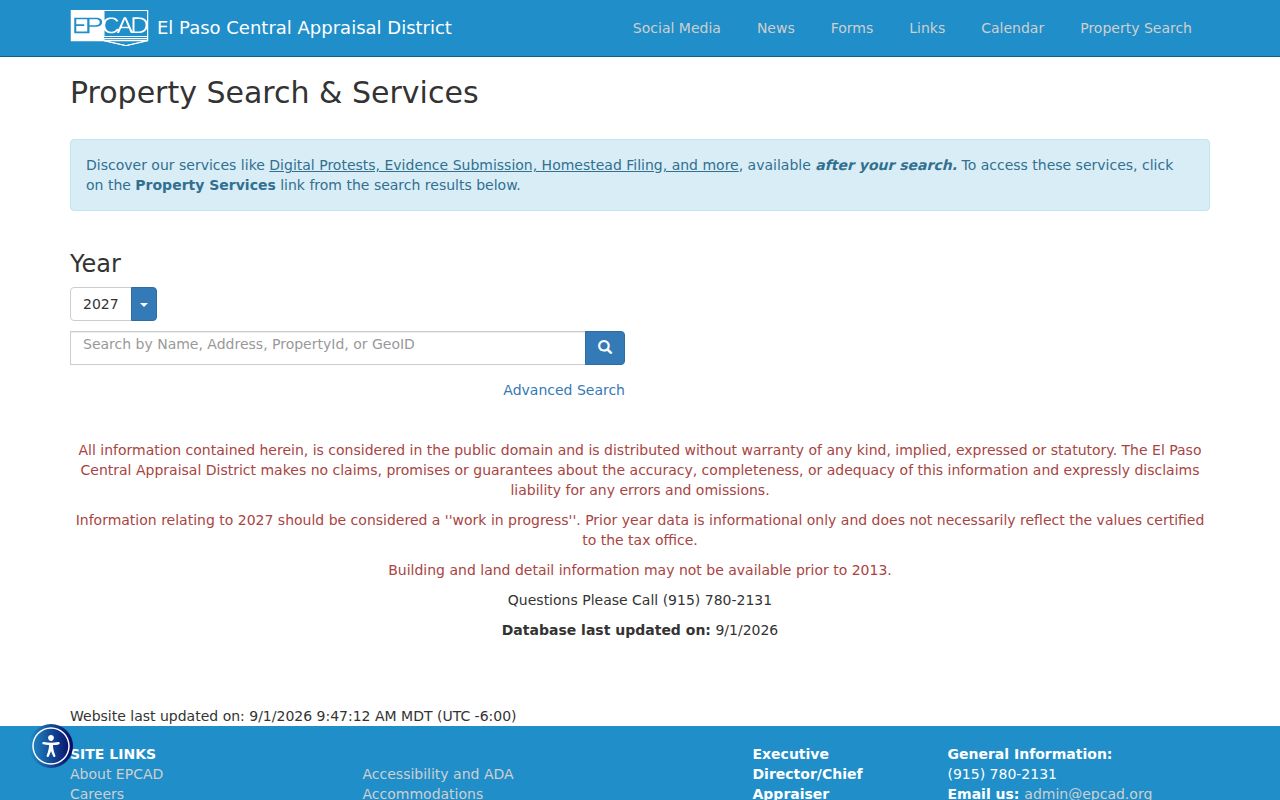
The basic screen places the tax-year selector above one text box, allowing an address lead to be compared with a specific appraisal-year context.
Enter a street number and street name when looking for one parcel. Use a street-name fragment only when the task is to browse a longer stretch, then narrow the result count with a number, subdivision, or GeoID. Results can show an account or property number, GeoID, owner name, and address field. Some result sets also display pagination and a download-result option. EPCAD's live interface showed 2027 work in progress, while prior-year searches remain informational, so preserve the year shown with every result.
| Socorro EPCAD field | How to enter it | Street-directory use |
|---|---|---|
| Basic query | Name, address, PropertyId, or GeoID | Initial parcel or owner lead |
| Advanced owner name | LastName FirstName or LastName | Compare a deed party to current accounts |
| Advanced address | StreetNumber StreetName or StreetName | Browse a specific Socorro street |
| Property ID | Account identifier | Return to one appraisal account |
| Geographic ID | GeoID identifier | Keep the parcel trail together |
| Subdivision and tax year | Advanced select fields | Narrow a repeat street name or compare a year |
The public HTML did not expose the current choice lists for subdivision, condo, tax year, type, sorting, or results-per-page. Do not assume their options from another system. EPCAD Open Government also provides appraisal-roll, CAMA, and GIS download information; an open-record request can be needed for detail that is not in a visible search result.
Read Socorro Parcel Addresses Carefully
One of the most important Socorro street directory limits is the difference between a property location and an owner mailing address. The parcel's situs is the physical location represented by its geometry and legal description. A mailing address is where tax correspondence goes. It may be another parcel, a business address, a post-office box, or an address outside Socorro. EPCAD's public result label was not enough to make that distinction definite, so call it an owner or address lead until parcel detail identifies the fields.
- Parcel
- A mapped unit of land tied to an appraisal account, a GeoID, and a legal description.
- Situs address
- The property location when the record specifically labels it as such, distinct from an owner's mailing address.
- Plat
- A recorded map that can show the lot, block, subdivision, street layout, dedication, or easement.
- Criss-cross directory
- An address-first historical directory, useful for comparing an old number with an occupant or business listing.
A homestead exemption can support an owner-occupancy lead, but it does not prove that the owner is the only person there. Family members, roommates, caregivers, and other household members may have no public property listing at all. The street directory should therefore say “parcel owner” or “recorded party” when that is what the record establishes.
Map Socorro Parcels by GeoID
The EPCAD property GIS at gis.epcad.org supplies the geographic half of the address chain. Use the subject address to identify its account or GeoID, locate the parcel, and then inspect adjacent parcel geometry one at a time. City Planning and Zoning also publishes zoning and district maps, and the city district map divides Socorro into four council districts. Those maps place a street in civic and land-use context.
The research did not verify the exact live layer names, identify controls, buffer tools, measurement tools, or export buttons in the current GIS viewer. Do not rely on a claimed radius or automatic adjacent-parcel tool without visual confirmation. A safe method is slower: write down each neighboring GeoID or account, return to EPCAD for that parcel, and compare only the public owner or address lead that appears there.
Socorro's history makes this caution useful. Acequia, mission, farm, colonia, and later subdivision geography can produce a record trail where an old route name, a current street label, and a stable legal tract do not look alike. When a map and an older directory disagree, compare plats, recorded legal descriptions, City Clerk annexation files, and newspaper references rather than forcing the old entry into a modern number.
Note: Parcel geometry identifies land relationships; it does not identify a household or confirm who occupies a nearby structure.
Socorro Street Records by Address
Address-keyed sources overlap, but they do not duplicate one another. EPCAD describes an appraisal account and owner lead. GIS shows parcel geography. Official Public Records describes recorded instruments and legal descriptions. A voter file, when properly requested, can provide limited registration-address context. City permit and code files can document an address event when released. A historical directory is a publication snapshot. Combining those sources creates a better Socorro street directory trail than relying on one screen.
| Address record | What it can show | What it cannot establish | Socorro access |
|---|---|---|---|
| EPCAD account | Owner, account, GeoID, address lead, tax-year context | All current occupants | Online search, download, or data request |
| GIS parcel | Geometry, subdivision, district or zoning context | Household identity | Viewer and map resources |
| Official Public Records | Parties, instrument, recording date, legal description | Continuous occupancy | County index and clerk-copy route |
| Voter file | Released registration and mailing address fields, districts, history | Protected voters or nonregistered household members | Written county or state request |
| Permit or code file | Address-specific application, inspection, notice, or closure material | Unreleased file content | Department or City Clerk request |
| Street directory | Dated occupant, business, intersection, or vacancy listing | Current residence or complete coverage | UTEP, Portal, library, or archives |
A parcel number can link the first three sources. The street name can link them more loosely, but names repeat and labels change. Keep the account, GeoID, lot, block, subdivision, filing date, and source URL with every note. That practice keeps a whole-street review from blending neighboring parcels or unrelated owners.
Follow Socorro Deed Chains
The County Clerk Official Public Records index is the link between a current Socorro parcel lead and a recorded transfer.
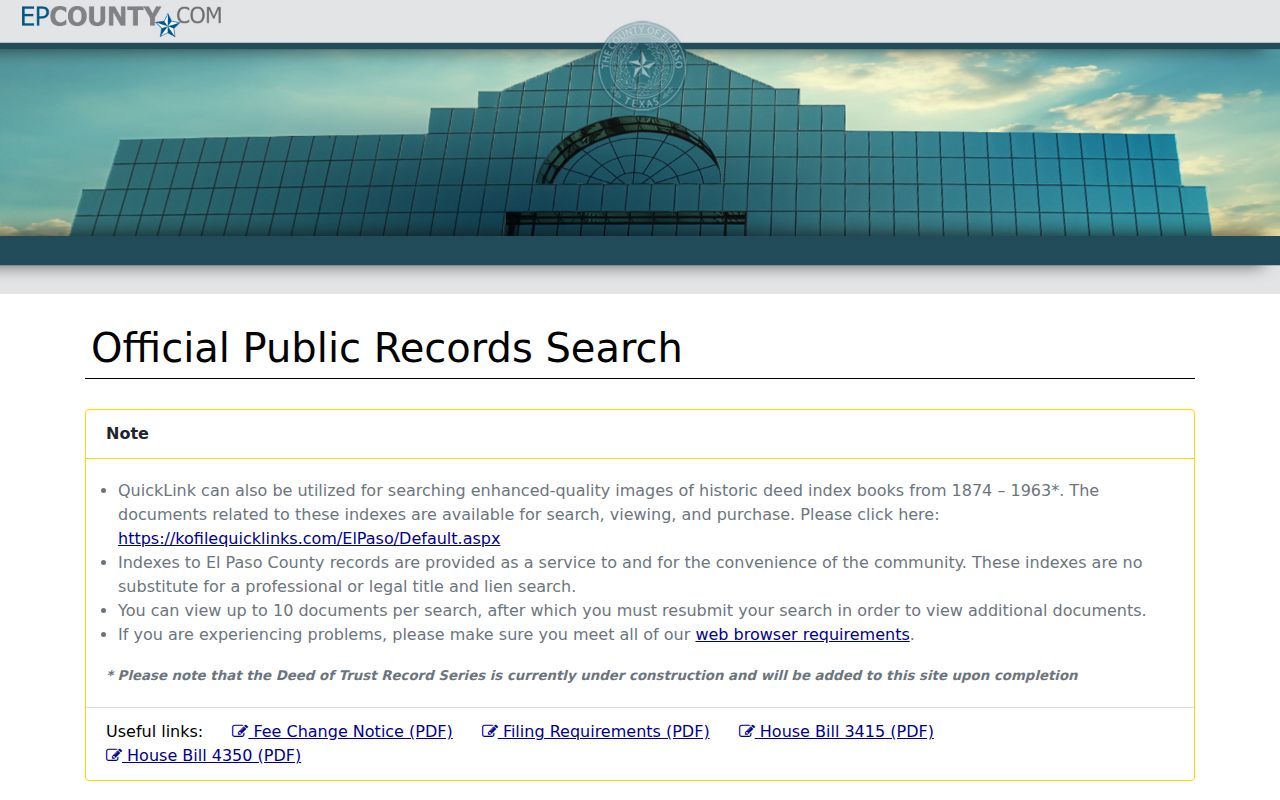
The form allows an instrument number, deed name, subdivision, style, book, page, lot, block, unit, tract, and filing-date criteria, making it more precise than an address-only search.
Search the current owner as grantee, the person receiving the transfer, and add the legal description where possible. The grantor is the person transferring the interest. A likely deed style, such as a warranty deed, deed, deed of trust, or release, can reduce same-name results. The form requires at least one criterion and returns up to ten documents. Capture the instrument number, grantor, grantee, style, recording date, book or page, and legal-description clues. Then search the seller as the prior grantee using the preceding date and same tract information.
Recorded maps, plats, easements, rights of way, covenants, liens, releases, foreclosure documents, probate material, and heirship filings can explain a change that does not read as an ordinary sale. A deed proves a dated transfer, not continuous residence. The public index also is not a title commitment. Request the record or consult a qualified professional when a legal conclusion depends on the chain.
Use Socorro Historic Deed Books
The El Paso historical grantor-grantee deed index supplies the older County Clerk route for a Socorro address trail.
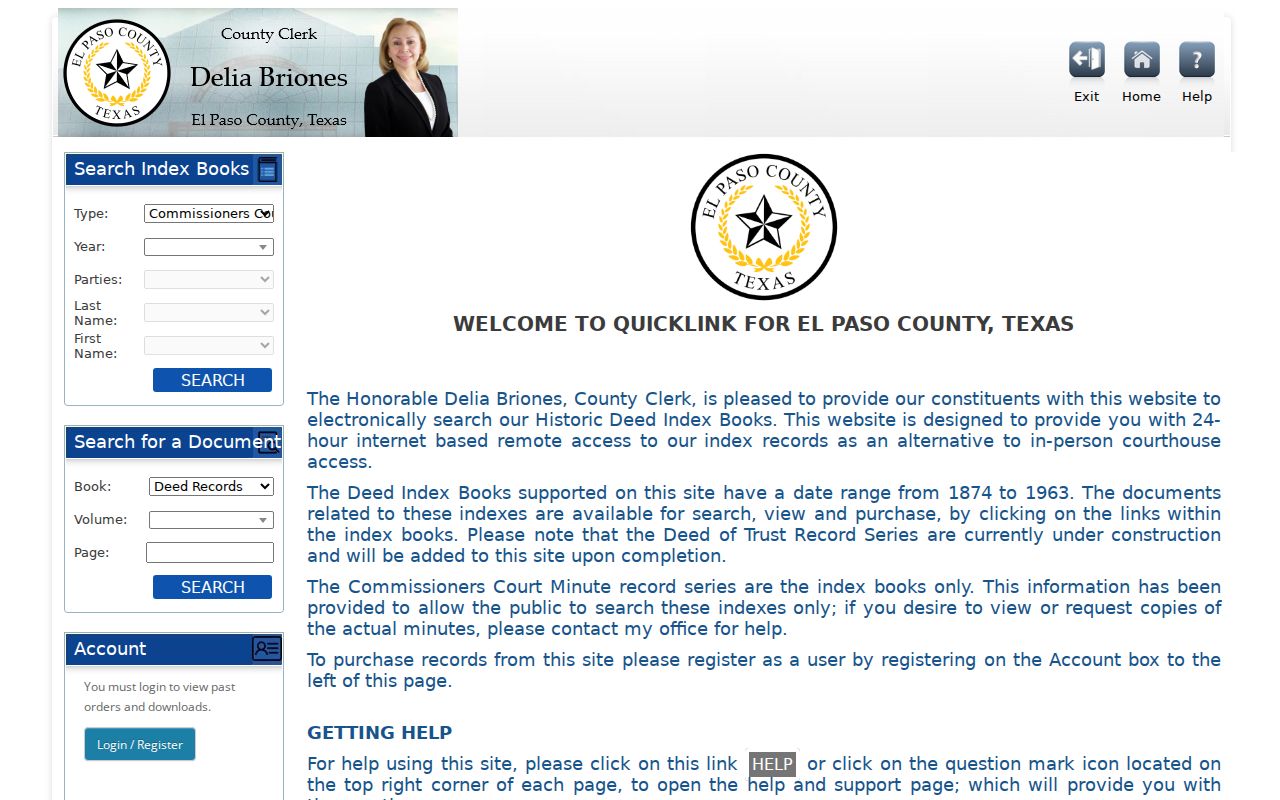
The county describes the online deed-index books as reaching from 1874 through 1963, with a separate document search by book, volume, and page.
This 1963 breakpoint matters. Use the current Official Public Records portal for later transfers, then shift to the historical books when the date requires it. Search by index-book type, year, party, last name, and first name. The route also describes a document search using book, volume, and page, with related documents that may be viewed or purchased after registration. The deed-of-trust series is marked under construction, and Commissioners Court minutes are index-only through the remote route, so an index hit may still require a County Clerk request.
The helpful habit is to carry the legal description backward, not simply repeat the modern street address. One tract can be split, a street label can change, and an older index may organize material by book or party. That legal-description trail is the strongest insider method when a Socorro address search produces no clean historical result.
Note: When a deed-book index ends, ask the County Clerk for the identified book and page before treating the trail as broken.
Socorro Voter Address Requests
El Paso County's public “Am I Registered?” lookup is a name, date-of-birth, or VUID match. It is not a street-wide search. For a lawful address-level voter question, the county's public-information procedure provides written requests for voter files, participating lists, particular elections, and certain voter history or registration records. Elections says county exports can be delivered in text or Excel formats and are prepaid.
Public fields described by the county can include county and state identification numbers, registered and mailing addresses, districts, registration dates, and voter history. Phone numbers, email addresses, full dates of birth, state identification numbers, Social Security numbers, and protected addresses are excluded. Texas Election Code Chapter 18 also limits use, including commercial advertising and promotional use. The Elections street master is useful for identifying street-to-district or precinct context without treating it as a resident list.
A request should name the election file, date range, street, records sought, and preferred format. Call Elections at (915) 273-3597 or use the county's request information to confirm the current form and cost before submitting. Do not publish a raw street roster or use protected information to target people.
Request Socorro Address Files
Socorro Planning and Zoning and Code Enforcement hold address-keyed material that does not have a located public case-search interface. Planning forms can identify an applicant, owner or contractor, address, plans, review comments, and issuance information. Code files can include complaint details, inspection dates, notices, violation descriptions, photographs, and closure status. Neither is a substitute for the property and deed records, but a dated file can clarify when a site changed.
Use the City Clerk or Socorro NextRequest for a narrow request. Include the street address, date range, record category, and requested document types, such as permit applications, review comments, inspection reports, notices, or closure material. The City Clerk says requests are generally processed within ten business days, with a possible fee based on volume. Planning and Zoning also accepts permit submissions by email, while Code Enforcement has its own department route.
Ask for public portions of a defined file. A request cannot override confidentiality rules, and a form alone does not establish that a project was approved or completed. If a result describes a legal description instead of the street number, connect it back through the plat and appraisal account before adding it to a Socorro street directory note.
Read Socorro Street Snapshots
The 1922 El Paso street-directory sample shows the address-first format available in the regional historical collection.
Street pages can list a number, an occupant or business, intersections, and the word “Vacant,” preserving a time-specific change rather than an assertion about a present household.
The 1922 Hudspeth Directory volume is 962 pages and includes personal, business, professional, classified, civic, and street material. A personal entry can give a name, title or descriptive shorthand, residence or rooming address, and telephone. Common shorthand includes `r` for residence or rooms, `rms` for rooms, `wid` for widow, and other volume-specific abbreviations. Check the front matter because the abbreviations can change between editions.
Socorro entries may be sparse, filed under El Paso, or described with a regional label. Search the name and the street number, then compare several adjacent years and a census year. A business location does not prove a home address, and the directory is never a full household inventory. The broader historical shelf belongs in the Socorro Directory Book, where the year runs and collection routes are described in depth.
Note: A “Vacant” label marks the directory's publication-time observation and should not be carried forward as a current conclusion.
Socorro Address Geography Changes
Street research in Socorro has a geographic limit before it has a name limit. The city boundary and district maps define municipal geography, the county ZIP map and USPS define postal geography, and EPCAD/GIS define the parcel. Those boundaries do not align perfectly. A Socorro mailing name or ZIP can sit in an unincorporated pocket, and a nearby address may use an El Paso postal designation. Verify each address separately before deciding which city office holds its record.
The city describes development history that can complicate older address research. Mission and irrigation landscapes, repeated floods, agricultural fields, colonia development, and the 1985 reincorporation following an annexation threat all left map, boundary, and planning records. No official historical street-renumbering schedule was located in the research. When a historic address does not match a modern label, use a plat, legal description, City Clerk ordinance or annexation paper, historic map, and newspaper reference to bridge it.
Socorro Street Directory Limits
A Socorro street directory can identify public parcel and record leads. It cannot show every household member, child, roommate, caregiver, utility customer, delivery recipient, driver-license holder, protected voter, sealed-case party, or unlisted historical occupant. An address that appears in a tax roll, deed, permit, court filing, or old directory may identify an owner, party, applicant, or historical listing rather than a person currently living there.
Texas confidential-address protections can conceal qualifying participants, and state law excludes key voter fields and protected addresses from public release. The federal motor-vehicle privacy law also blocks DMV data as a street-directory source. Treat a withheld field as a boundary, not as an invitation to reconstruct private information from unrelated sources. A public record is most useful when it is cited narrowly and compared honestly with its limits.
Check a Socorro Street Trail
Before relying on an address result, repeat the short chain: confirm the current parcel account, distinguish property location from mailing address, record the GeoID and legal description, locate the dated instrument, and compare an independent source. A mismatch can be meaningful. It can show a transfer, a changed mailing address, a subdivided tract, an old directory error, or a record that belongs to another person with a similar name.
- Keep the exact Socorro address as searched and any alternate street spelling or suffix.
- Save the EPCAD tax year, account number, GeoID, and date accessed.
- Record the County Clerk instrument number, parties, style, and filing date.
- Use lot, block, subdivision, tract, or plat details to connect older records.
- Describe each result as owner, recorded party, applicant, or historical occupant when that is the supported role.
For a full historic collection, use the Directory Book. For a current name that needs separate verification, use the Resident Lookup route in the navigation. The street directory remains strongest when it stays focused on the address, parcel, instrument, and dated street evidence.
Note: Preserve both the record date and access date, since Socorro portal content and counter availability can change.